
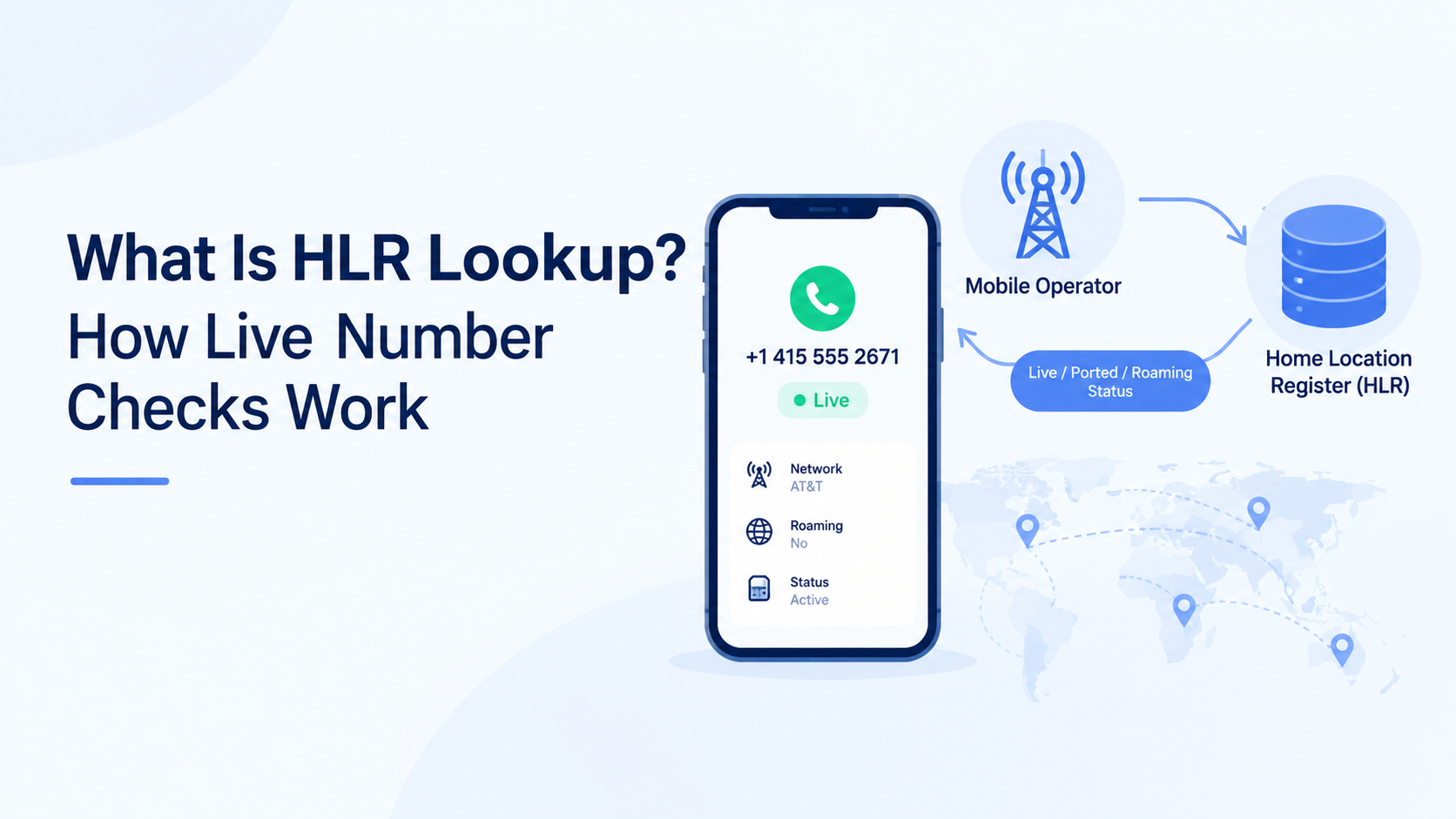
| An HLR lookup is a real-time query to a mobile operator’s Home Location Register, the database that tracks every subscriber on its network. It tells you whether a mobile number is currently active, which network it belongs to right now (even after porting), and whether it is roaming. Format validation can only tell you a number could exist. |
Table of Contents
Key Takeaways
- The Home Location Register is the operator database that holds each subscriber’s identity, subscription status and current location on the network.
- An HLR lookup answers “is this number live right now?”, which is a different question from “is this number correctly formatted?”
- HLR is the reliable way to detect ported numbers, because it reports the network that actually serves the subscriber today.
- Landlines have no HLR, so HLR lookups only work on mobile numbers, and coverage varies by country and operator.
- Most teams pair a fast, cheap validation API for every number with HLR checks only where live status changes the decision.
If you have ever sent an SMS campaign and watched a chunk of it fail on numbers that looked perfectly fine, you have hit the gap HLR lookups fill. A number can pass every format rule and still belong to a SIM card that was cancelled last year. This post explains what the Home Location Register is, what a lookup returns, and where it fits next to the carrier lookup and validation checks you probably already run.
What is an HLR lookup?
An HLR lookup is a real-time query against a mobile network’s Home Location Register that returns the subscriber’s live status, the network currently serving the number, and roaming information. It works by asking the network the same question it asks itself before delivering an SMS: where is this subscriber, and can they be reached?
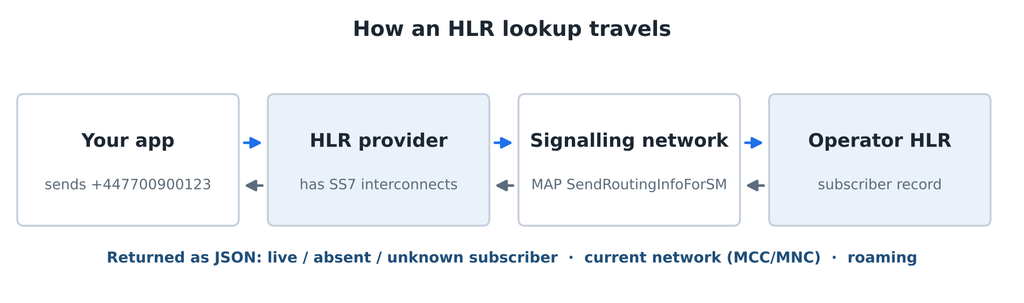
Technically, the HLR is defined in the 3GPP GSM/UMTS standards (3GPP TS 23.002), and lookups ride on the MAP signalling protocol over SS7. In practice, you never touch SS7 yourself. An HLR provider with interconnect agreements sends a routing query (usually SendRoutingInfoForSM, the same message used to route a text) and returns the answer to you as JSON.
4G and 5G networks moved the function into the HSS and UDM respectively, but the industry still calls the whole category “HLR lookup”, and the data you get back is the same shape.
What the Home Location Register actually stores
Think of the HLR as the operator’s master record for every SIM it has issued. The fields that matter for a lookup are few:
| Field | What it is | Why you care |
|---|---|---|
| MSISDN | The phone number as dialled, in international form | The key you query with |
| IMSI | The SIM’s unique subscriber identity; its first digits encode country (MCC) and network (MNC) | Reveals the real home network, which is how porting gets detected |
| Serving switch (MSC/VLR address) | The network node currently handling the subscriber | Shows roaming: a serving switch in another country means the user is abroad |
| Subscription status | Whether the subscription is active, barred or deleted | Separates live numbers from dead ones |
| Reachability flags | Set when the network has failed to reach the handset | Hints that the phone is off or out of coverage |
Most providers do not return the raw IMSI for privacy reasons. They return the decoded MCC/MNC, a network name, and a status code instead.
What HLR tells you that format validation cannot
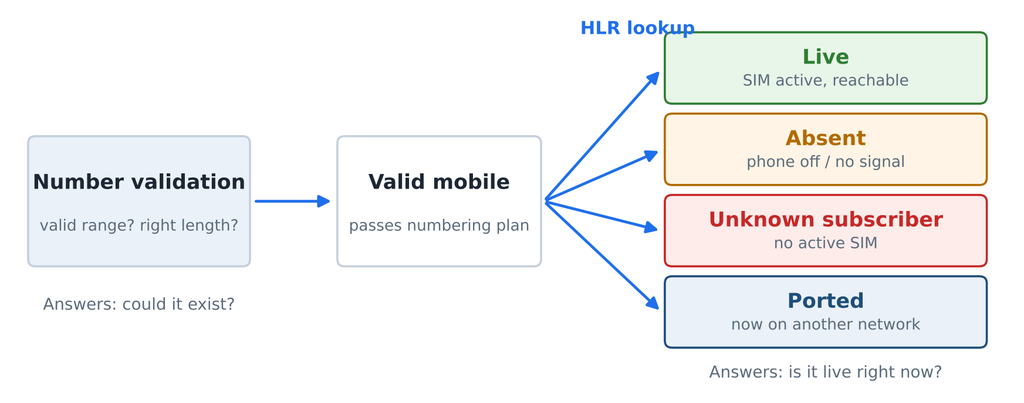
This is the distinction that matters. Number validation checks a number against the numbering plan: right length, real country code, a prefix range that has been allocated to an operator. That tells you the number is valid. It cannot tell you the number is live, because the numbering plan has no idea whether someone is paying for that SIM today.
The HLR does know. It is the system of record for active subscriptions, so a lookup can come back with three answers validation can never give you:
- Unknown subscriber. The number is in a valid range but no SIM is attached to it. Common for cancelled prepaid lines and numbers waiting to be reassigned.
- Absent subscriber. The subscription exists but the network cannot reach the handset right now. The phone is off, out of signal, or the SIM is sitting in a drawer.
- Ported. The number was originally allocated to one operator but now lives on another.
Porting is the big one. In the US, wireless number portability has been mandatory since 2003 (FCC), and most other markets followed. Any lookup that infers the carrier from the number’s prefix returns the operator the range was allocated to, which after a port is simply the old carrier. The HLR answers with the operator that serves the subscriber today, because that is the network the query actually lands on.
That matters if you route SMS by carrier, price messages by destination network, or score fraud risk based on the operator. For all three, the current network is the one you want.
HLR lookup vs a number validation API
These are complementary tools, and most teams end up using both. Here is how they compare:
| Number validation API | HLR lookup | |
|---|---|---|
| Question answered | Is this a real, correctly formatted number? | Is this mobile number live right now? |
| Data source | Numbering plans and carrier allocation data | The operator’s live subscriber database |
| Works on | Mobile, landline, toll-free, special services | Mobile only |
| Carrier returned | The operator the number range is assigned to | The operator currently serving the number |
| Typical speed | Fast, suited to every form submit | Slower; depends on the remote network |
| Typical cost | Low per lookup | Higher per lookup |
| Best for | Signup forms, CRM hygiene, line type routing | High-value SMS, fraud checks, deciding which old numbers to keep |
A validation call such as the Numverify number validity check returns structured data you can act on immediately, including the line type and the allocated carrier:
{
  "valid": true,
  "number": "14158586273",
  "local_format": "4158586273",
  "international_format": "+14158586273",
  "country_prefix": "+1",
  "country_code": "US",
  "country_name": "United States of America",
  "location": "Novato",
  "carrier": "AT&T Mobility LLC",
  "line_type": "mobile"
}
A sensible order of operations: validate everything first, because it is fast and cheap and it removes the malformed numbers and landlines that would waste an HLR query. Then send only the valid mobile numbers where live status changes your decision to an HLR check.
Use cases where that split pays off:
- Signup forms. Validation is enough. You want to catch typos instantly, and the user is right there to fix them.
- OTP and 2FA delivery. Validation at entry, plus an HLR check when an OTP fails to deliver, so support can see whether the phone is off or the number is dead.
- Old contact lists. HLR before a big SMS send, so you only pay to message numbers that can receive it.
- Carrier-based routing. HLR, because porting makes prefix-based carrier data unreliable for routing decisions.
Where teams use it: SMS delivery, fraud screening, list cleaning
SMS delivery
Every message sent to an unknown subscriber is paid for and never delivered. For one-off transactional messages the waste is small. For a campaign to a list collected years ago it adds up, and repeated failures to dead numbers can hurt your standing with the aggregator. An HLR pass on the list’s mobile numbers before the send removes the dead weight.
Fraud screening
Two HLR signals are useful in risk scoring. A number that was ported very recently can point to a SIM swap or port-out attack, especially when it shows up right before a password reset. And a subscriber who is roaming in a different country from the one the account claims is worth a second look. Neither signal is proof of fraud on its own; both are good inputs to a score.
List cleaning
Numbers decay. In the US alone, the FCC estimated that about 35 million numbers are disconnected and reassigned every year (FCC 18-177). If you are cleaning a large list, the full pipeline (normalize, dedupe, validate, then segment) is covered in our walkthrough on cleaning a 50,000 number list. HLR slots in after validation for the mobile segment.
Limits and compliance
HLR is powerful, but it has real edges you should plan around:
- Landlines have no HLR. Fixed lines are managed by different systems, so an HLR query on a landline returns nothing useful. Check line type first.
- Coverage varies by operator. Some operators restrict or filter routing queries from outside their network, often as part of SS7 security hardening recommended by the GSMA. Results can be partial or masked in those markets, and quality varies between providers.
- “Absent” is a moment in time. A phone that is switched off now may be on in ten minutes. Treat absent subscribers as “retry later”, not “delete”.
- Personal data rules apply. A phone number tied to a person is personal data under the GDPR. You need a lawful basis (often legitimate interest for fraud prevention or keeping your records accurate), you should document it, and you should avoid storing more of the HLR response than you need.
- Lookups are generally legal through licensed providers, but local telecom rules differ. If you operate in a regulated sector, check with your counsel for the markets you query.
HLR is a specialist tool, and it works best on top of solid validation. For the everyday job of confirming a number is real and identifying its carrier and line type, start with a carrier lookup.
FAQs
What is HLR lookup used for?
HLR lookup is used to check whether a mobile number is active before you message or call it, to detect ported numbers so SMS is routed to the right network, and to add live-status and roaming signals to fraud checks.
Is HLR lookup legal?
Yes, HLR lookups through licensed providers are generally legal. Because phone numbers are personal data, you still need a lawful basis under privacy laws such as the GDPR, and local telecom rules vary by country.
Can HLR detect a switched-off phone?
Often, yes. When the network cannot reach a handset it flags the subscriber as absent, and an HLR lookup returns that status. It reflects one moment in time, so a phone reported as absent may be reachable again shortly.
Does HLR work on landline numbers?
No. The Home Location Register only exists for mobile subscribers. To check a landline, use a number validation API, which confirms the number is valid and returns its line type and allocated carrier.